Replacing or restoring a tooth often feels confusing and expensive. Between filling, inlay, onlay, and crown, it’s normal to wonder which option is best for your tooth and your budget. Understanding the difference between these restorations helps you make a more confident decision with your dentist.
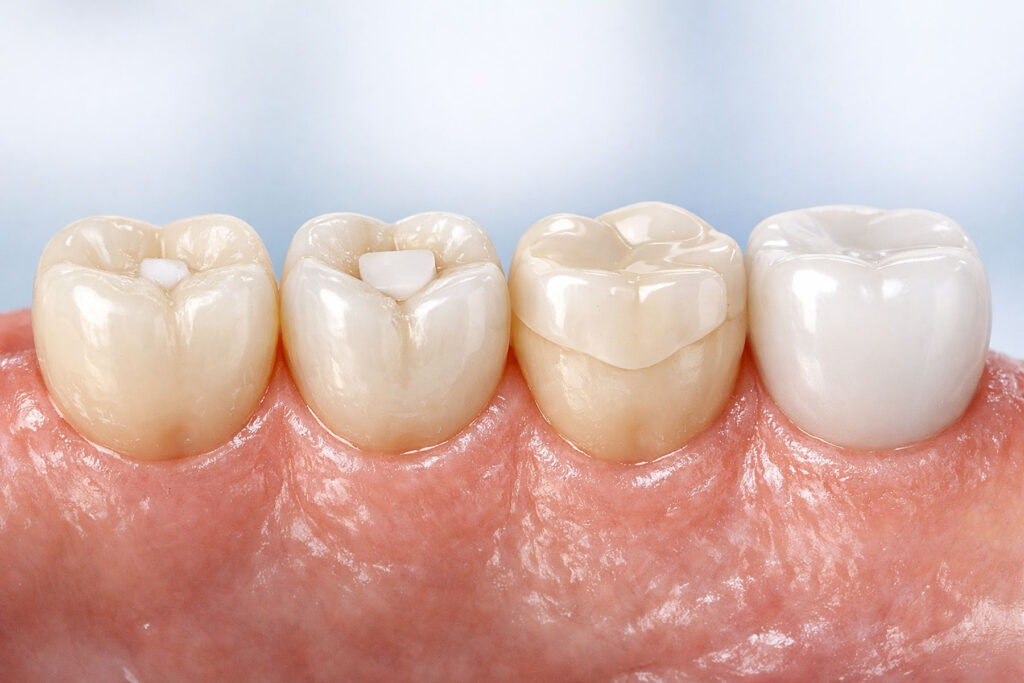
💠 Dental Filling vs. Inlay
In theory, you can sometimes use these two options interchangeably. However, dentists typically reserve inlays for much larger cavities.
Both treatments start the same way: the dentist removes the existing cavity with a drill and then fills that space. The main difference lies in how that space is restored:
- Filling (direct restoration)
With a filling, an amalgam or composite material goes directly into the prepared space. The dentist shapes and hardens it chairside. This makes it a much quicker process that usually involves only a single visit. - Inlay (indirect restoration)
With an inlay, the space is filled with a single, solid piece that a lab usually fabricates. Typically, inlays use materials like gold or ceramic. The inlay must match the shape and size of the space very precisely. If it does not, food and bacteria can enter the gap and cause further decay.
The upside to an inlay is that the material does not contract as much as a filling after placement. As a result, there is less chance of the filling–tooth interface breaking down or forming a gap between the restoration and the surrounding tooth structure. Inlays also create a tougher and, in theory, more durable surface for chewing. Because of that, an inlay can be more reliable long term, although current data on this is mixed and not completely conclusive.
🧩 Onlays vs. Dental Crowns
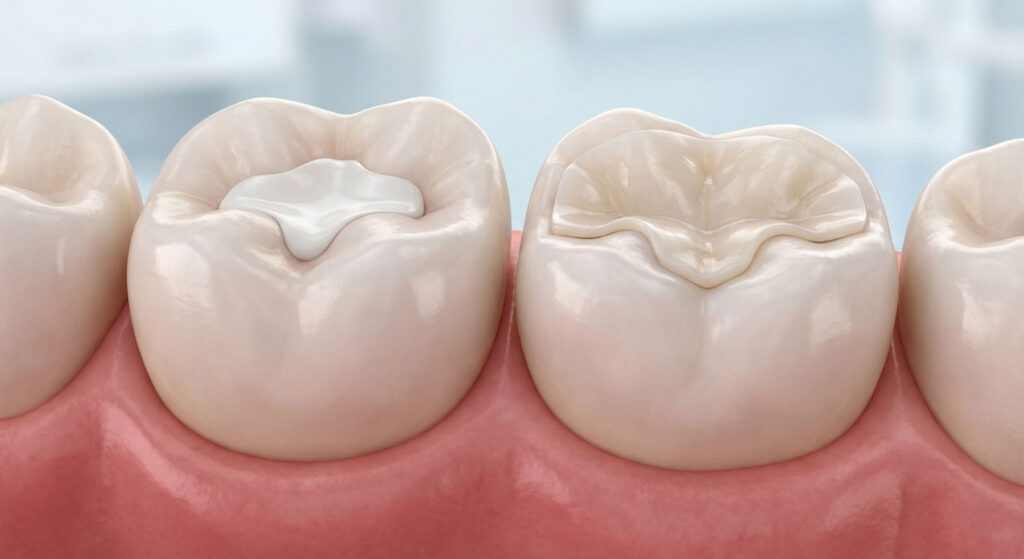
Onlays and dental crowns are more extensive single-tooth restorations. Dentists use them for larger areas of decay where a filling or inlay will not work because they would need to remove too much tooth structure.The primary distinction between an onlay and an inlay is coverage:
- An onlay covers at least one cusp of the tooth.
- An inlay only fills the area between the cusps.
The dentist still drills out the cavity and then fabricates an onlay to the exact size and shape of the space.
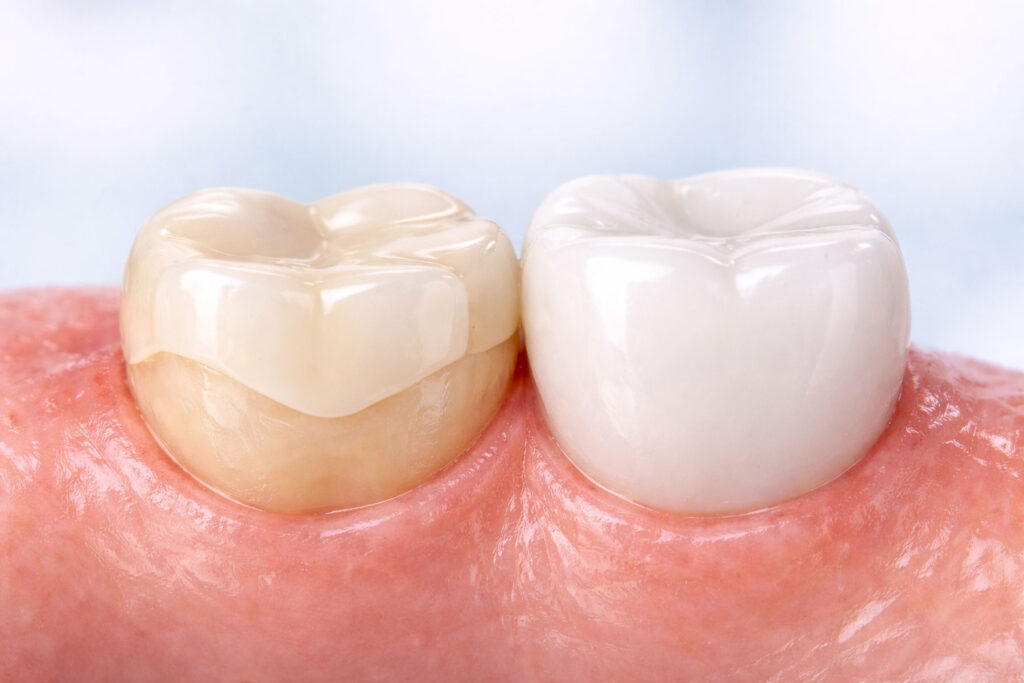
By contrast, a dental crown covers the entire biting surface of the tooth as well as all tooth structure above the gum line. It acts like a full “cap” around the tooth.
Compared to a crown, an onlay is a less aggressive restoration when it is clinically possible to use one, since the dentist removes less natural tooth structure to place the onlay. The costs are similar, but an onlay is usually a little cheaper than a crown. For that reason, an onlay is often the preferred restoration when the tooth allows it.
However, there is a tradeoff: an onlay can be more challenging to perform correctly and relies heavily on the skill and precision of the dentist.
😄 Choosing Between a Filling, Inlay, Onlay & Crown
Whether you need a filling, inlay, onlay, or crown, the best choice depends on how much tooth structure remains, the location of the tooth, your bite, and your long-term goals.
At Smiles For Health, we offer a variety of restorative and cosmetic dentistry services so you can smile with confidence.